
Tag Archives: Boston500

Boston500 Members: Professionals in Finance, Law, Insurance, Real Estate

The Members of Boston 500: Professionals in Finance, Law, Insurance, Real Estate

An Exclusive Network of Verified Leaders Across Finance, Law, Insurance, and Real Estate

Welcome to the Boston 500 Member Network—a curated, high-authority collective of independent professionals and practice leaders across Greater Boston.

Boston and its surrounding 124 municipalities form one of the most vibrant, high-net-worth, and legally nuanced markets in the United States. Navigating real estate transactions, business growth, tax strategy, and asset protection in Eastern Massachusetts requires specialized local expertise.

Boston 500 connects elite local practitioners across four interconnected pillars—Finance, Law, Insurance, and Real Estate—creating a unified cross-referral ecosystem engineered for local market dominance and next-generation search visibility.

1. Real Estate Professionals

The real estate market in Greater Boston is defined by high demand, historic property considerations, strict zoning laws, and rapid competitive cycles. From luxury residential enclaves in Boston’s Back Bay, Beacon Hill, and South End to suburban growth hubs across MetroWest, the North Shore, and the South Shore, success hinges on local precision.

  • Target Members: Premier Licensed Real Estate Agents, Managing Brokers, and Commercial Real Estate Specialists.

  • Greater Boston Application: Our Real Estate members represent local neighborhood expertise. They lead buyer and seller representation across residential single-family homes, multi-family investment properties, and commercial developments. Positioned at the top of the transaction cylinder, they initiate the core buyer and seller relationships that drive local commerce.

2. Real Estate Closing Attorneys & Legal Counsel

Massachusetts is an “attorney state” (under M.G.L. c. 93, § 70), making real estate attorneys functionally mandatory for conducting title exams, issuing title insurance, and overseeing mortgage closings. Beyond conveyancing, individuals and business owners across Greater Boston require trusted legal counsel for estate planning, business formation, and asset protection.

  • Target Members: Independent Real Estate Closing Attorneys, Conveyancers, Title Practitioners, and Estate/Business Lawyers.

  • Greater Boston Application: Our Legal members anchor every property transaction in Massachusetts. Working hand-in-hand with agents and lenders, closing attorneys ensure clear title transfers, draft complex purchase and sale (P&S) agreements, and protect client interests across all 124 Greater Boston municipalities.

3. Mortgage Lenders & Finance Professionals

Securing financing in Greater Boston’s high-value property market demands deep loan-product knowledge and fast execution. Financing needs range from first-time homebuyer programs in urban centers to high-balance jumbo loans, construction financing, and commercial credit across affluent suburbs like Newton, Wellesley, and Concord.

  • Target Members: Licensed Mortgage Loan Originators (MLOs), Independent Mortgage Brokers, Bank Loan Officers, and Private Commercial Lenders.

  • Greater Boston Application: Mortgage members power the purchasing force of the region. By delivering tailored loan structures, rapid pre-approvals, and competitive rates, they bridge the gap between property search and closing day, ensuring seamless coordination with closing attorneys and real estate agents.

4. Insurance Agencies & Producers (P&C + Life & Health)

Protecting physical assets and long-term financial health is critical in New England. Real estate buyers must secure Property & Casualty (P&C) coverage prior to closing, while business owners, executives, and families require comprehensive Life & Health (L&H) insurance strategies.

  • Target Members: Independent P&C Insurance Agents, Commercial Risk Brokers, and Dedicated Life & Health (L&H) Agencies.

  • Greater Boston Application:

    • P&C Specialists: Integrated directly into local property closings, issuing homeowners insurance binders, flood policies, and commercial liability coverage required by lenders.

    • L&H Specialists: Provide key-person insurance, employee group benefits, annuities, and family wealth protection policies across high-income suburban corridors.

5. Wealth Managers, Financial Planners, CPAs & EAs

Beyond individual property transactions, Greater Boston’s high concentration of tech founders, medical professionals, corporate executives, and multi-generational families require sophisticated wealth management and tax optimization.

  • Target Members: Independent Registered Investment Advisors (RIAs), Certified Financial Planners (CFPs), Certified Public Accountants (CPAs), and Enrolled Agents (EAs).

  • Greater Boston Application: Our Wealth and Accounting members manage long-term portfolio growth, tax planning, IRS representation, and estate liquidity. Grouped into the top 50 regional hubs, they ensure clients preserve capital and structure their wealth efficiently.


The Power of the Quad-Linked Ecosystem
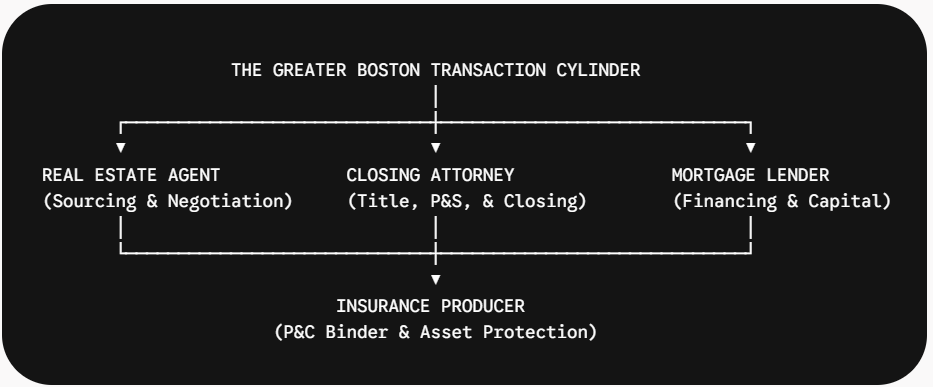
By bringing these four interconnected segments together under strict local page limits (a maximum of 5 members per page in top hubs and 3 members in suburban towns), Boston 500 eliminates fragmented referrals.

Every member profile is engineered with advanced JSON-LD Schema structured data—ensuring that when clients or conversational AI engines (ChatGPT, Gemini, Calude, Perplexity, MetaAI on WhatsApp) search for the most trusted professionals in any Greater Boston town, our members stand out as the verified local authority.

Member Onboarding Questionnaire

Boston 500 Member Onboarding Questionnaire

Complete Your Profile & Activate Your Local AI Search Visibility

Congratulations on securing your Founding Membership with Boston 500!

To engineer your schema-optimized profile, lock in your municipality rank, and index your practice across conversational AI engines (ChatGPT, Gemini, Perplexity, Apple Intelligence), please review the questionnaire below and email your completed details to: members@boston500.com

Quarterly Profile Refresh Guarantee: Your online authority is a living asset. Every quarter, our team will update your profile with new milestones, client wins, or media links —ensuring AI search engines and LLMs continuously view your practice as an active, verified local authority.

Section 1: Core Practice & Contact Credentials

Please provide your exact business details as you would like them to appear on your official profile page and in our structured JSON-LD schema markup:

1. Full Legal Name & Professional Credentials:
(e.g., Jane Doe, Esq. / John Smith, CFP®)

2. Primary Industry & License Type:
(Select one: Real Estate Agent / Real Estate Closing Attorney / Mortgage Loan Originator / P&C Insurance Agent / Life & Health Insurance Agent / Wealth Manager (RIA/CFP) / Accountant (CPA/EA))

3. State License / CRD / NMLS / Bar Number:
(Required for verification)

4. Business / Practice Name:
(e.g., Beacon Hill Legal Group / MetroWest Wealth Management / Marblehead Life Insurance Agency)

  • 5. Office Address:
    (Street Address, Suite #, City/Town, Zip Code)

  • 6. Direct Phone Number:
    (The primary line clients should call; you can also give two phone numbers if you want)

  • 7. Direct Email Address:
    (For client inquiries and Boston 500 communications)

  • 8. Official Website URL:
    (Link to your primary firm or personal landing page)

Section 2: Geographic Target & Primary Municipality Selection

Boston 500 assigns membership positions on a municipality-by-municipality basis:

  • 1. Primary Municipality Page: (Select 1 primary city/town from our 124 Greater Boston locations where you want your permanent rank assigned, e.g., Newton, Wellesley, Woburn, Boston)

  • 2. Secondary Service Areas: (List up to 3 neighboring towns where you frequently serve clients)

Section 3: Professional Biography & Practice Specialties

Help us highlight what sets your practice apart to local clients and AI search graphs:

  • 1. Professional Biography (150–300 Words): (A brief overview of your background, experience in Greater Boston, and core philosophy)

  • 2. Key Areas of Specialization: (List 3 to 5 core focus areas, e.g., Jumbo Mortgages, First-Time Buyers, Commercial Property Title, Tax Resolution, HNW Estate Planning)

  • 3. Years in Practice / Local Market Experience: (Number of years serving Eastern Massachusetts)

Section 4: Media, Visual Assets & Video Embedding

High-resolution visual media elevates your profile aesthetics and enhances image SEO across Google and conversational search interfaces:

  • 1. Headshot / Professional Portrait:

    • Option A (Preferred): Provide a direct URL to your professional headshot hosted on your website or LinkedIn. (We will optimize and host the asset locally with descriptive image SEO labeling).

    • Option B: Attach a high-resolution JPG or PNG directly to your onboarding email.

  • 2. Firm / Office Logo:

    • Option A (Preferred): Provide a direct URL to your high-resolution logo online.

    • Option B: Attach your logo file (PNG or SVG preferred) to your email.

  • 3. Featured Video (YouTube Embeds Only):

    • If you have an introductory video, client greeting, or market update video, please provide your YouTube Video URL. (We exclusively embed YouTube URLs directly onto your profile page for maximum responsive speed and rich video schema indexing).

Section 5: Client Testimonials & Social Proof (Optional)

Including real client reviews strengthens authority signals for prospective clients and conversational search graphs:

  • Share 3 to 5 Client Testimonials: (Include the client’s quote and first name/initial, e.g., “Jane guided us through a complex Newton closing with total confidence.” — Mark T., Newton)

  • Note: This section is optional during initial setup. You may submit testimonials at any point, or we will collect them during your monthly check-ins and quarterly profile refreshes.

How to Submit Your Information

  1. Copy and paste the sections above into an email (or attach a Word document/PDF).

  2. Attach any images or paste your direct image/YouTube URLs into the email body.

  3. Please send your completed submission by email to members@boston500.com with the subject line:
    [Your Name] - Boston 500 Member Onboarding.

Once received, our engineering team will build your custom profile, insert your structured JSON-LD Schema, assign your timestamped rank, and send you your live URL within 3 business days.  However, that’s just the start of our engagement with you. Over the next 3-4 weeks, we will study your profession in your location and your competitors, and we will improve your profile further based on the exact search queries and questions we are seeing from your potential customers.

Our goal is to build a very high quality  profile page for you that establishes you as the go-to expert in your profession, in your location/town/city. And this goal will be achieved step by step as we study your location, your market, and constantly update your profile page to make it the best.

The Future of Work in Boston: AI, Automation, Robotics, Biotech & Opportunities

Boston has always been a city of reinvention.💙

From a colonial port to an industrial hub…
From a manufacturing center to a university powerhouse…
From a finance and healthcare capital to a global biotech leader…

Now, in 2026, Boston stands at the center of another transformation — one driven by artificial intelligence (AI), automation, robotics, and advanced biotechnology.

The future of work isn’t arriving all at once. It’s unfolding across labs in Kendall Square, robotics facilities in Waltham, AI startups in Cambridge, hospitals in the Longwood Medical Area, and corporate offices downtown.

The question isn’t whether change is coming.
It’s how Boston will shape it — and who stands to benefit.


AI: From Research to Real-World Deployment

Boston’s AI ecosystem is anchored by world-class institutions like MIT and Harvard, but in recent years, artificial intelligence has moved decisively beyond academia.

Today, AI applications in Greater Boston span:

  • Drug discovery and protein modeling
  • Financial risk analysis
  • Healthcare diagnostics
  • Supply chain optimization
  • Climate modeling
  • Legal tech and compliance

AI is no longer a niche specialty. It is becoming infrastructure — embedded across industries.

For Boston’s workforce, this means two parallel shifts:

  1. High-skill AI development roles are expanding.
    Data scientists, machine learning engineers, and computational biologists remain in strong demand.
  2. AI is reshaping traditional roles.
    Professionals in law, healthcare, finance, and marketing are integrating AI tools into daily workflows.

Rather than eliminating entire sectors, AI in Boston is augmenting expertise — especially in industries already rich in technical talent.


Automation: Quietly Transforming Operations

Automation often operates behind the scenes. In Greater Boston’s hospitals, automated systems streamline scheduling and diagnostics. In logistics hubs along Route 128, warehouse automation improves efficiency. In biotech manufacturing facilities, robotic systems ensure precision in production.

While AI often grabs headlines, automation is reshaping operational work across:

  • Manufacturing
  • Healthcare administration
  • Retail distribution
  • Laboratory processes

For workers, this means repetitive tasks are increasingly digitized or mechanized.

The opportunity lies in transition: roles shift from performing routine functions to overseeing, maintaining, and optimizing automated systems.

Boston’s strong community college network and workforce retraining programs will play a critical role in helping mid-career workers adapt.


Robotics: Engineering the Physical Future

Few cities rival Boston in robotics innovation. From research labs to commercial startups, robotics companies across Cambridge, Somerville, and Waltham are advancing:

  • Autonomous vehicles
  • Warehouse robotics
  • Medical robots
  • Humanoid systems
  • Defense and security applications

Robotics blends software, hardware, AI, and mechanical engineering — disciplines Boston’s universities excel in.

The impact on work is twofold:

  • New engineering and design roles are emerging rapidly.
  • Certain physical labor tasks may decline as automation becomes more sophisticated.

Yet robotics also creates adjacent opportunities — maintenance, integration, sales engineering, regulatory oversight.

Importantly, Boston’s robotics ecosystem remains heavily innovation-driven. It is not just deploying technology; it is inventing it.


Biotech: Still Boston’s Flagship Industry

While AI and robotics evolve quickly, biotech remains Boston’s cornerstone. The region continues to lead in:

  • Gene editing
  • mRNA technologies
  • Oncology research
  • Rare disease therapeutics
  • Cell and gene therapy

Biotech jobs span far beyond research scientists. The ecosystem supports:

  • Clinical operations specialists
  • Regulatory affairs professionals
  • Bioinformatics analysts
  • Manufacturing technicians
  • Quality assurance experts

As computational biology and AI converge with traditional wet-lab science, interdisciplinary roles are expanding. The lab of the future increasingly includes both pipettes and predictive algorithms.


Hybrid Work and Physical Space

One of the most visible changes since 2020 has been hybrid work.

In Boston:

  • Traditional office sectors have downsized or reconfigured space.
  • Lab and research environments remain largely in-person.
  • Tech startups operate on flexible attendance models.

The result is a split work landscape.

Downtown Boston continues to adapt to hybrid corporate schedules, while Kendall Square and the Longwood Medical Area maintain consistent physical presence due to lab requirements.

Real estate strategies now reflect this divergence:

  • Flexible office layouts
  • Increased lab conversions
  • Mixed-use developments near transit

The future of work in Boston is not purely remote nor fully centralized — it is hybrid and sector-specific.


Opportunities for Students and Young Professionals

For students graduating from Boston’s universities, the opportunity landscape remains robust — but evolving.

High-demand skill sets include:

  • Machine learning and data analytics
  • Bioinformatics
  • Regulatory science
  • Robotics engineering
  • Cybersecurity
  • Healthcare technology

However, technical skills alone are not enough.

Employers increasingly value:

  • Interdisciplinary collaboration
  • Ethical reasoning in AI and biotech
  • Communication skills
  • Adaptability

Boston’s competitive advantage lies in its educational density. Students can intern at startups, research institutions, hospitals, and venture firms — often within a few miles of campus.

The pipeline from classroom to career remains one of the region’s greatest strengths.


Risks and Workforce Disruption

No discussion of the future of work is complete without acknowledging risk.

Automation and AI may reduce demand for certain administrative and repetitive roles. Entry-level corporate positions that once involved routine analysis or documentation are increasingly supported by software tools.

This raises key questions:

  • How can mid-career workers retrain efficiently?
  • Will wage gaps widen between technical and non-technical roles?
  • Can Boston maintain inclusive economic growth?

Workforce development initiatives will be critical. Public-private partnerships, community college programs, and employer-sponsored training must evolve alongside technological change.

Boston’s innovation economy has historically generated wealth — but ensuring that opportunity is broadly shared remains an ongoing challenge.


The Role of Climate and Health Innovation

Beyond AI and robotics, Boston is positioning itself at the intersection of climate and health technology.

Climate tech startups are working on:

  • Carbon capture
  • Renewable energy storage
  • Sustainable materials
  • Climate data analytics

Meanwhile, health tech companies are leveraging AI for:

  • Remote patient monitoring
  • Personalized medicine
  • Diagnostic imaging

As global demand grows for sustainable and health-focused innovation, Boston’s research base gives it a competitive edge.

Future job growth may increasingly intersect technology with societal needs.


A City Built for Knowledge Work

Boston’s future of work is deeply tied to knowledge-intensive industries.

Unlike regions dependent on large-scale manufacturing, Boston’s economy centers on:

  • Research
  • Advanced services
  • Education
  • Healthcare
  • Technology development

This positioning makes the city relatively resilient to automation shocks that disproportionately affect routine industrial labor.  However, it also reinforces the need for continuous education.

In Boston, learning is not a phase — it is a career-long requirement.


What This Means for Greater Boston

As AI, automation, robotics, and biotech converge, Boston’s workforce will likely become:

  • More technical
  • More interdisciplinary
  • More innovation-driven
  • More globally connected

Commercial real estate will continue adapting. Universities will deepen industry partnerships. Venture capital will flow toward deep-tech ventures.

Neighborhoods like Kendall Square, the Seaport, and Longwood will remain central nodes of activity.

At the same time, suburban innovation corridors along Route 128 will continue expanding.


Final Thoughts

The future of work in Boston is not defined by a single technology. It is defined by convergence.

Artificial intelligence informs biotech.
Robotics integrates with healthcare.
Automation enhances manufacturing.
Climate innovation intersects with engineering.

Boston’s advantage lies in its density of talent, research institutions, and venture capital — all within a highly collaborative urban ecosystem.

Change is accelerating. Some roles will evolve. Others will disappear. Many new ones will emerge. But if history is any guide, Boston will not simply react to the future of work. It will help invent it. 💙

Boston Biotech Boom: What’s Driving Investments in 2026

Boston has long been synonymous with biotechnology. But in 2026, the conversation isn’t just about scientific leadership — it’s about capital.

Despite broader market volatility over the past several years, investment in Boston’s biotech ecosystem remains resilient. Venture funding, strategic pharmaceutical partnerships, and institutional backing continue to flow into Greater Boston at levels that reinforce its global dominance.💙

So what’s driving biotech investment in 2026?

The answer lies in a powerful combination of scientific depth, infrastructure, capital concentration, and long-term conviction in life sciences innovation.


1. A Deep and Durable Research Pipeline

At the foundation of Boston’s biotech strength is its research engine.

Institutions like MIT, Harvard, Boston University, and a network of world-renowned teaching hospitals continuously generate intellectual property, breakthrough discoveries, and spinout companies.

In 2026, key research areas attracting funding include:

  • Gene editing and CRISPR-based therapies
  • Cell and gene therapy manufacturing
  • Oncology and immunotherapy
  • Rare disease treatments
  • AI-driven drug discovery
  • mRNA platform expansion

Investors are drawn to Boston because innovation here is not episodic — it is structural. The pipeline of new ideas is steady and renewable.

Unlike emerging biotech hubs that rely on a handful of high-profile companies, Boston’s ecosystem produces dozens of early-stage ventures each year.


2. Convergence of AI and Biotech

One of the biggest accelerators of investment in 2026 is the intersection of artificial intelligence and biology.

AI-driven platforms are now being used to:

  • Model protein structures
  • Accelerate compound screening
  • Predict clinical trial outcomes
  • Identify novel drug targets

Boston’s strength in both computational science and life sciences makes it uniquely positioned to capitalize on this convergence.

Investors increasingly favor startups that blend wet-lab biology with machine learning infrastructure. Companies that once required years of manual experimentation can now compress discovery timelines.

This hybrid model appeals to venture capital firms seeking scalable, data-rich platforms rather than single-asset biotech bets.


3. Mature Venture Capital Infrastructure

Boston’s biotech boom is not fueled solely by scientific breakthroughs — it’s powered by capital concentration.

The region hosts a dense cluster of life sciences-focused venture capital firms. Many partners have advanced scientific degrees, enabling sophisticated diligence and long-term strategic guidance.

In 2026, investors are demonstrating:

  • Greater selectivity in early-stage funding
  • Larger Series B and C rounds for de-risked companies
  • Increased participation in crossover public-private financing

While funding cycles fluctuate, Boston’s ecosystem benefits from institutional memory. Investors here have navigated multiple biotech market cycles. This maturity creates stability. Capital may tighten during uncertain periods — but it rarely disappears.


4. Big Pharma’s Continued Presence

Global pharmaceutical companies maintain substantial footprints in Greater Boston.

Their presence drives investment in several ways:

  • Corporate venture arms participate in early-stage funding rounds
  • Strategic partnerships provide non-dilutive capital
  • Acquisitions create exit pathways
  • Research collaborations reduce risk

For startups, proximity to major pharma partners is invaluable.

In 2026, licensing deals and strategic alliances are increasingly common, allowing biotech companies to advance clinical programs while sharing financial risk.

This integrated model reinforces Boston’s attractiveness to both founders and investors.


5. Specialized Real Estate and Lab Infrastructure

Unlike software startups, biotech companies require sophisticated lab space.

Over the past decade, developers across Cambridge, Boston, Watertown, and Somerville have built purpose-designed laboratory facilities. Flexible lab suites allow early-stage companies to scale gradually.

Although lab vacancy rates have fluctuated alongside broader capital cycles, Boston’s infrastructure remains among the most advanced in the world.

Investors take comfort in this physical foundation. Companies launching in Boston can quickly secure compliant space, access shared equipment, and operate within established biotech corridors.

The physical ecosystem supports rapid commercialization.


6. Federal and State Policy Support

Government funding and policy frameworks continue to play a meaningful role in biotech investment.

Federal research grants through agencies like the NIH fuel early-stage academic research that later spins out into startups.

At the state level, Massachusetts has consistently prioritized life sciences through tax incentives, workforce development programs, and innovation grants.

In 2026, public-private collaboration remains central to the ecosystem’s momentum.

Investors often view Boston as lower risk compared to newer biotech markets because of this layered institutional support.


7. Global Talent Magnetism

Biotech investment ultimately follows talent.

Boston attracts:

  • PhD researchers
  • Postdoctoral fellows
  • Clinical trial experts
  • Regulatory professionals
  • Bioinformatics specialists

The concentration of universities and hospitals ensures a steady workforce pipeline.

Moreover, many scientists trained in Boston choose to remain in the region, launching startups or joining growing ventures.

For investors, talent density reduces execution risk. A company’s success often hinges on assembling the right scientific and operational team — something Boston consistently enables.


8. Resilience Through Diversification

Another factor driving 2026 investment is diversification within biotech itself.

Boston is not dependent on a single therapeutic area. The biotech ecosystem spans:

  • Oncology
  • Neurology
  • Cardiovascular disease
  • Autoimmune disorders
  • Genetic medicine
  • Infectious disease

When one subsector experiences clinical setbacks, others may continue to advance and provide opportunities for jobs and investments.

This diversification stabilizes investment patterns.
Capital rotates — it does not abandon the region.


9. Long-Term Healthcare Demand

Underlying every investment decision is a fundamental macro reality: global healthcare demand continues to grow.

Aging populations, rare disease research, personalized medicine, and chronic condition management all require innovation.

Biotech is inherently long-term. Clinical trials may take years. Regulatory approval processes are rigorous. Yet the potential payoff — both financial and societal — remains compelling.

In 2026, investors are increasingly disciplined, but conviction in the long-term necessity of biomedical innovation remains strong.

Boston sits at the epicenter of that conviction.


Challenges Beneath the Boom

Despite strong investment flows, the ecosystem is not without pressure.

  • Capital markets remain sensitive to interest rates and macroeconomic conditions.
  • Early-stage companies face higher expectations for data and milestone clarity.
  • Lab space costs and operating expenses remain elevated.
  • Competition for top-tier talent is intense.

Investors are scrutinizing business models more closely than during previous expansion cycles. However, this selectivity may ultimately strengthen the ecosystem, favoring companies with robust science and clear commercialization strategies.


Final Thoughts

Boston’s biotech boom in 2026 is not a speculative bubble. It is the product of structural advantages built over decades:

  • World-class research institutions
  • Deep venture capital networks
  • Proximity to global pharmaceutical companies
  • Sophisticated lab infrastructure
  • Dense scientific talent

Investment may ebb and flow with market cycles, but the underlying drivers remain intact.

In a world increasingly shaped by health innovation, Boston continues to attract capital not just because it is successful — but because it is foundational.

Biotech breakthroughs don’t happen overnight. But in Boston, the conditions that make them possible are firmly in place. 💙


From Lab to Launch: Inside Kendall Square’s Startup Ecosystem

On any given weekday morning in Kendall Square, you’ll see a familiar scene: researchers walking briskly between lab buildings, founders huddled over coffee, venture capitalists heading to pitch meetings, and biotech teams reviewing trial data in glass-walled offices.

Compact in geography but global in impact, Kendall Square has earned its reputation as “the most innovative square mile on the planet.” But that label isn’t just branding. It reflects a deeply interconnected ecosystem where science, capital, talent, and infrastructure converge.

In 2026, Kendall Square remains one of the world’s premier launchpads for startups — particularly in biotech, life sciences, artificial intelligence, robotics, and climate tech.

Here’s how the ecosystem works — and why it continues to produce companies that shape industries worldwide.


The Anchor: Research Institutions

At the heart of Kendall Square’s ecosystem are its institutional anchors. MIT is the gravitational force. Its laboratories, research centers, and entrepreneurial culture generate a constant stream of ideas — from breakthrough therapeutics to next-generation computing platforms. 💙

Harvard University, just across the river, adds depth in medicine, public health, and applied sciences. Research hospitals across Greater Boston further expand the pipeline of discovery.💙

What makes Kendall unique isn’t just the presence of top-tier institutions — it’s proximity. Faculty, graduate students, postdocs, and founders interact constantly. A research insight in a university lab can quickly become the basis for a venture-backed startup.

The line between academia and industry is deliberately thin.


The Lab-to-Startup Pipeline

The startup journey in Kendall often follows a familiar arc:

  1. Academic research yields promising data.
  2. Technology transfer offices help secure intellectual property.
  3. Faculty or researchers form a founding team.
  4. Early-stage investors provide seed funding.
  5. The company secures lab space nearby.
  6. Growth capital accelerates clinical or product development.

The density of resources shortens this timeline. Unlike regions where founders must travel between cities for funding, lab access, and talent, Kendall Square concentrates everything within walking distance. This compression of geography translates into speed — and in biotech especially, speed matters.


Venture Capital in Walking Distance

Kendall Square’s startup ecosystem thrives on capital access.

Many venture capital firms specializing in life sciences and deep tech maintain offices in or near the neighborhood. Founders can pitch investors without boarding a plane. This proximity fosters:

  • Frequent informal meetings
  • Faster diligence processes
  • Deep sector specialization
  • Long-term investor-founder relationships

Investors aren’t generalists; they often hold advanced scientific degrees and understand complex clinical pathways or technical challenges. The result is an ecosystem where capital is not just abundant — it is informed.


The Role of Big Pharma and Tech Giants

While startups are the stars, established corporations play a critical supporting role.

Over the past decade, major pharmaceutical and biotech companies have established innovation hubs in Kendall Square. Global firms maintain research outposts, partnership offices, and venture arms nearby.

Similarly, major technology companies have expanded engineering and AI research footprints in Cambridge. Their presence matters for several reasons:

  • They provide exit opportunities through acquisitions.
  • They form strategic partnerships with early-stage startups.
  • They employ experienced operators who later become founders.

Kendall Square operates as both incubator and marketplace. Startups grow independently — but remain connected to global industry players.


Lab Space: The Infrastructure Advantage

Unlike traditional tech startups that can launch from laptops, biotech and hardware companies require specialized facilities.

Wet labs, advanced equipment, ventilation systems, and regulatory-compliant infrastructure are expensive and complex. Kendall Square’s real estate market has adapted accordingly.

Purpose-built lab buildings dominate the skyline. Flexible lab suites allow early-stage companies to scale incrementally. Co-working lab spaces provide shared access for smaller teams.

Although lab rents are high, the ecosystem’s density justifies the cost. Companies gain access not only to infrastructure — but to community.

Even in 2026, as hybrid work reshapes office markets elsewhere, demand for high-quality lab space remains comparatively strong. Scientific work cannot be fully remote.


Talent Density and Cross-Pollination

Talent is Kendall’s most powerful currency.

The neighborhood draws:

  • PhD scientists
  • Engineers
  • Data scientists
  • Regulatory specialists
  • Clinical trial managers
  • Serial entrepreneurs

Employees often move between startups, academic labs, and larger firms — carrying institutional knowledge with them.

This fluidity creates cross-pollination. Best practices spread quickly. Lessons from failed ventures inform new ones. Networks deepen over time.

In many cases, startup teams are built through existing relationships formed at MIT, Harvard, or previous ventures in the area.

Trust accelerates collaboration.


The Culture of Experimentation

Kendall Square’s startup culture is ambitious — but notably pragmatic. In biotech especially, timelines are long and failure rates are high. Clinical trials may take years. Regulatory hurdles are significant. Yet the ecosystem embraces calculated risk.

Founders here are often deeply technical. They understand the science intimately. Investors, in turn, recognize that breakthrough innovation requires patience. The culture rewards:

  • Rigorous data
  • Transparent communication
  • Collaborative problem-solving

Networking events, industry panels, and academic conferences create a steady exchange of ideas.


Startups Beyond Biotech

While life sciences dominate headlines, Kendall Square’s ecosystem extends beyond biotech.

Artificial intelligence startups leverage proximity to MIT’s computer science programs. Robotics firms draw from world-class engineering talent. Climate tech ventures benefit from interdisciplinary collaboration between scientists, policy experts, and entrepreneurs.

This diversification strengthens the ecosystem. When biotech funding cycles fluctuate, AI or climate tech may surge. The cross-sector presence reduces reliance on any single industry.


Challenges Beneath the Success

Kendall Square’s growth has not been without friction.

Rising Costs

Lab space, housing, and operating expenses remain high. Early-stage companies must raise significant capital simply to secure space and talent.

Housing affordability affects recruitment. Employees often commute from surrounding communities due to high Cambridge rents.

Competition for Talent

As the ecosystem expands, competition intensifies. Startups compete not only with each other, but with well-capitalized global firms offering lucrative compensation packages.

Market Cycles

Venture funding ebbs and flows. In tighter capital markets, startups must extend runway and prioritize capital efficiency. The ecosystem has weathered funding slowdowns before — but volatility remains part of the landscape.


Community and Urban Integration

Unlike isolated corporate campuses, Kendall Square integrates into the broader fabric of Cambridge.

Retail spaces, restaurants, residential towers, and public plazas have expanded in recent years. The neighborhood feels less like a purely commercial district and more like a mixed-use urban hub.

This matters for talent attraction. Employees want walkability, dining options, and public transit access. The Red Line connects Kendall directly to downtown Boston and beyond.

Urban vitality enhances professional productivity.


Why Kendall Still Matters in 2026

In a world where remote work has reshaped traditional office sectors, Kendall Square demonstrates that place still matters — especially for innovation.

Scientific collaboration benefits from physical proximity. Lab work requires hands-on experimentation. Serendipitous hallway conversations still spark ideas.

The density of knowledge, capital, and infrastructure in Kendall creates momentum that is difficult to replicate elsewhere.

Startups launching here gain more than a mailing address. They gain immediate immersion in one of the most sophisticated innovation ecosystems on the planet.


Final Thoughts

From lab bench to product launch, Kendall Square offers a compressed, high-powered pathway for startups.

Academic research feeds entrepreneurial ambition. Venture capital fuels experimentation. Corporate giants provide scale and exit routes. Specialized real estate supports complex scientific work.

The ecosystem is not inexpensive, nor is it immune to market cycles. But its resilience lies in its interconnectedness.

In 2026, Kendall Square remains a place where ideas don’t just originate — they accelerate. And in a global innovation economy, acceleration makes all the difference. 💙